
The independent heating and cooling company across Kentucky and the Ohio Valley
Pre-Season Cooling Checks Worth Doing
You flip the thermostat to cool on the first warm Saturday and hope for the best. Maybe it runs. Maybe it hums and blows room-temperature air. Either way, you would rather know now than at nine o'clock on a ninety-five degree night. Here is what we look at before the first hot week, and what you can check yourself.
Call (888) 414-3292- A real person answers
- Open 7 days
- Written quote before work starts
Taking calls until 5:00 PM ET
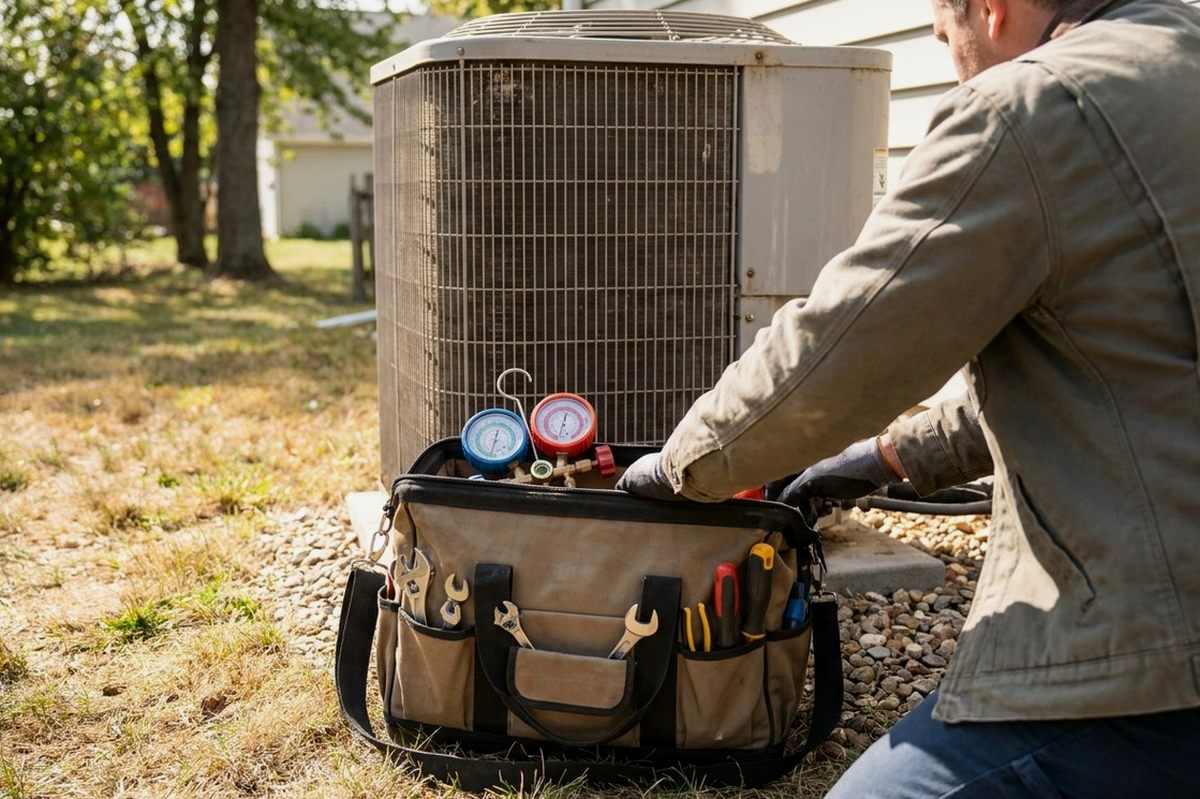
Derby City Comfort service team · field-reviewed before publishing
What Spring And Summer Actually Do To Your System
Across the region, cooling equipment sits idle for six or seven months, then gets asked to run most of the day. That gap is where trouble hides. Capacitors weaken over the winter and fail on the first hard start. Condensate drains clog with the previous year's dust and algae, then back up the moment the system starts pulling humidity out of the air. Outdoor coils collect cottonwood, grass clippings and pollen, which chokes heat transfer and pushes the compressor harder. Older homes with original ductwork lose capacity in hot attics. None of it shows up in April. All of it shows up in July.
Which Failures Spike, And When
The first genuinely hot stretch brings the biggest wave of calls, and most of them are electrical. Failed capacitors, burnt contactors and tripped breakers on systems that sat all winter. By midsummer the pattern shifts to refrigerant issues and airflow. Systems that were slightly low on charge in May now run long cycles, ice up, and freeze the coil solid. Late summer brings drain and drip problems, water stains on ceilings, and blower motors that have been running fourteen hours a day since June. Heat pumps get a second wave in the first cold snap, when the reversing valve or defrost board finally gets tested.
The Checks You Can Safely Do Yourself
Start with the thermostat. Fresh batteries, set to cool, fan on auto, and a set point at least a few degrees below room temperature. If nothing happens, look at the breaker panel for a tripped breaker and the disconnect near the outdoor unit. Change the filter. A filter that has been in since Thanksgiving will starve the blower and can freeze the indoor coil. Walk outside and clear leaves, mulch, grass and any stored items back a couple of feet from the condenser. Inside, open every supply and return vent, including in rooms you do not use. That is the safe list. Anything involving refrigerant, gas or line voltage is ours.
What A Pre-Season Visit Covers
We measure rather than guess. That means checking amp draw on the compressor and blower motor, testing capacitors against their rated values, inspecting the contactor for pitting, and reading temperature split across the indoor coil to see whether the system is actually moving heat. We flush the condensate drain and confirm the float switch works, because a stuck switch either floods a ceiling or shuts you down for no reason. We wash the outdoor coil, check refrigerant pressures against outdoor conditions, and look at duct connections in basements and crawlspaces. If something is marginal, we tell you now, while it is a scheduled repair instead of an emergency.
When To Call Instead Of Waiting
Call for air conditioning repair if the system runs but the house never catches up, if you hear a hum without the fan turning, if the breaker trips more than once, or if you see ice on the refrigerant lines or water pooling near the indoor unit. Smells matter too. A burning odor from the vents means shut it down and call. If you ever smell gas or a carbon monoxide alarm sounds, get everyone out of the house first, then call 911 or your gas utility from outside, and call us after that. We handle AC repair, air conditioner repair and heating repair for homeowners across Illinois, Indiana, Kentucky, Ohio, Tennessee and West Virginia.
Pre-Season Cooling Checks Worth Doing — what people ask
When is the best time to have my AC checked?
Anytime from March through May, before the first sustained hot week. Once temperatures climb, schedules fill fast and a small problem found in spring becomes an emergency call in July. Earlier is better than later.
My AC worked fine last September. Does it still need a check?
Yes. Most first-hot-day failures are parts that degraded quietly over the winter, like capacitors and contactors. A system can shut down in fall working perfectly and refuse to start in May with no warning at all.
Why does my AC freeze up in summer?
Usually restricted airflow or low refrigerant. A clogged filter, closed vents or a dirty coil starve the system, and the coil ices over. Turn the system off, switch the fan to on to thaw it, and call us.
How it works
- Step 1
Tell us the symptom
Call or fill in the quote form. We ask what changed, when it started, and what the thermostat reads. That short conversation tells us whether you need a visit today or tomorrow morning.
- Step 2
We diagnose on site
A technician checks the thermostat, the electrical side, airflow through the filter and ducts, and the equipment itself. We find the actual cause instead of swapping parts and hoping the noise goes away.
- Step 3
You decide before we work
We explain what failed, what the repair involves, and what we would do if it were our own house. Nothing gets replaced until you say go. Then we test the system before leaving.
- A real person answers
- Open 7 days
- Written quote before work starts
Why homeowners call us
- Old houses and new onesWe are used to century-old homes with retrofitted ductwork and 1970s subdivisions with original returns. Tight crawl spaces, low basement headroom and odd attic runs are normal parts of the day for us, not surprises that stall the job.
- Built for the swingsHumid summers push AC systems hard and January freezes expose weak igniters and cracked flues. We repair for both extremes across the region, so the fix holds when the weather turns instead of failing the first hard week.
- Air conditioning and heating bothAir conditioner repair in July, heating repair in January, and the IAQ and airflow problems that hide in between. One crew that knows how your cooling and heating share the same blower and the same duct system.
- Plain talk, no pressureWe tell you when a repair makes sense and when replacement is the honest answer. No scare tactics about your BTU load, no upsell scripts. You get the condition of the system and a clear next step.
- All major brands, gas & electricEvery major HVAC brand, gas and electric, handled by an independent crew.
- Straight answersIf a system is not worth repairing, we say so, often right on the phone.
About this guide
When the easy checks change nothing, it's time for a tech
Tell us what you tried and what it did. The booking itself takes a minute.
- A real person answers
- Open 7 days
- Written quotes
- All major brands
- Gas & electric
Rather not call? Get a free quote →